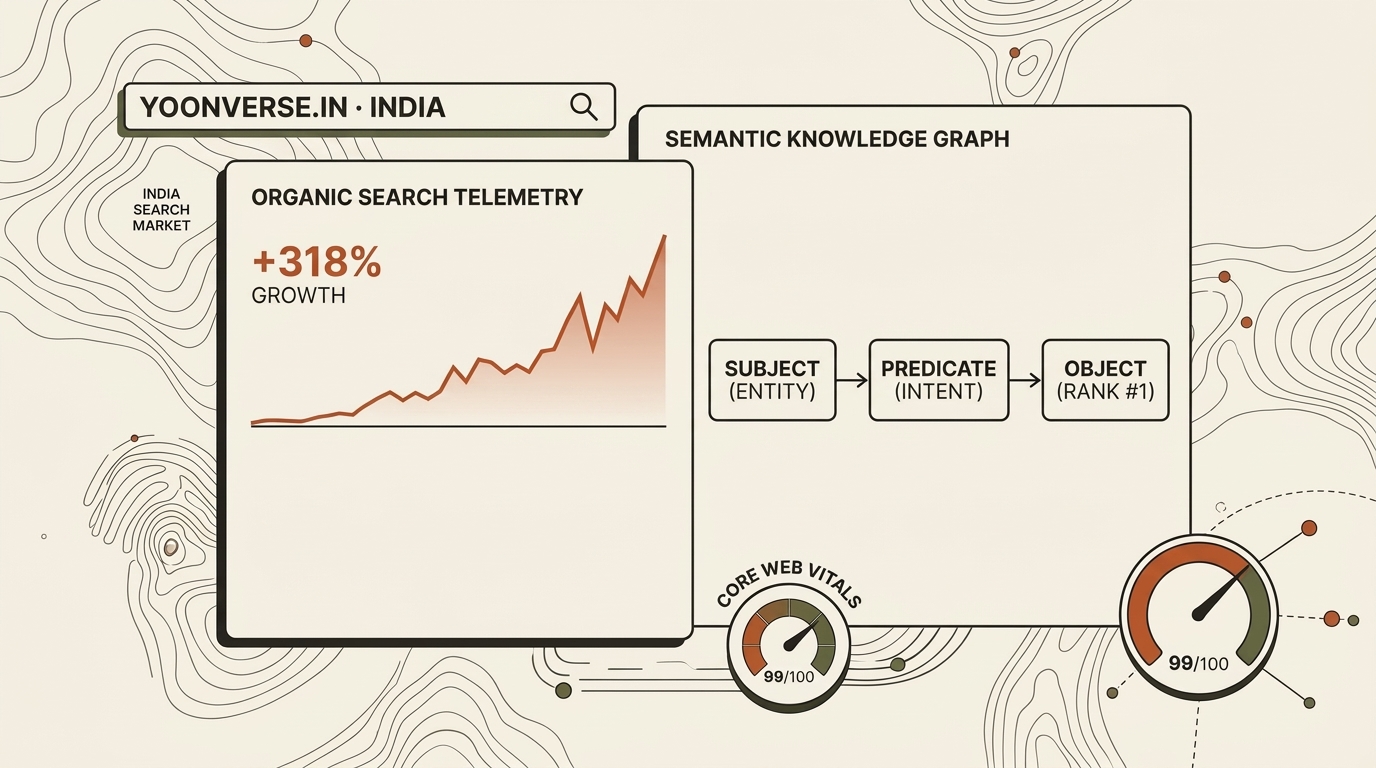
- [Google Knowledge Graph] —(parses prose into)→ [Subject-Predicate-Object (SPO) Triples]
- [Entity-Attribute-Value (EAV) Architecture] —(reduces)→ [Search Engine Cost of Retrieval]
- [Semantic Salience & Contextual Depth] —(outrank)→ [Exact-Match Keyword Stuffing]
Semantic SEO is the practice of engineering web documents around real-world entities, their attributes, and their logical relationships rather than isolated keyword strings. Modern information retrieval systems—including Google's Knowledge Graph, MUM, and Gemini—do not merely count how many times a phrase appears on a page; they extract verifiable facts structured as semantic triples.
1. What is Semantic SEO?
Traditional SEO treated search queries as literal strings of characters. If a user searched for an industry specialist in a specific country, legacy sites repeated that exact phrase ten times in the HTML. Today, search engines resolve queries by mapping entities (people, places, concepts, organizations) inside a multidimensional vector space.
When your document clearly defines who an entity is, what credentials and methodologies it possesses, and which geographic or topical ecosystem it serves, Google's Natural Language Processing (NLP) pipeline assigns a high entity salience score to your URL.
2. Understanding Semantic Triples (Subject – Predicate – Object)
A semantic triple is an atomic unit of factual meaning composed of three parts: a Subject (Entity), a Predicate (Relationship or Verb), and an Object (Value or Target Entity).
| Subject (Entity) | Predicate (Relation) | Object (Target Entity / Value) | Search Engine Interpretation |
|---|---|---|---|
| Googlebot | discovers URLs via |
XML Sitemaps & Internal Links | Establishes technical crawlability context |
| Ashiq (Yoonverse) | architects |
Semantic SEO Systems in India | Links Person entity to Occupation & Country (Q668) |
| Topical Authority | lowers |
Algorithmic Cost of Retrieval | Connects content cluster depth to ranking stability |
| Above-the-Fold Visuals | reinforce |
Centerpiece Annotation & E-E-A-T | Validates multimodal Vision AI relevance |
3. Entity-Attribute-Value (EAV) Content Modeling
Closely related to SPO triples is the Entity-Attribute-Value (EAV) data model. Whenever Google generates a Knowledge Panel, Featured Snippet, or AI Overview comparison, it queries an internal table of attributes for the central entity.
- Entity: Core Web Vitals (
Q106832951) - Attribute 1 (Largest Contentful Paint): Measures visual loading performance; target threshold is under 2.5 seconds.
- Attribute 2 (Interaction to Next Paint): Measures input responsiveness; target threshold is under 200 milliseconds.
- Attribute 3 (Cumulative Layout Shift): Measures visual layout stability; target threshold is below 0.1.
By using semantic HTML5 elements such as <dl> (definition lists), <table> with explicit <th> headers, and structured H2/H3 hierarchies, you hand-deliver EAV data directly to the parser.
4. How Domains Rank Without Exact-Match Keyword Stuffing
Suppose someone searches for a leading organic search analyst in India. A spammy page repeats that literal string in every heading. An authoritative semantic domain instead demonstrates:
- Explicit Entity Identity: A verified
PersonandOrganizationgraph linking the strategist's name,.incountry-code top-level domain, andworkLocation: India. - Topical Cluster Depth: Interconnected, original guides covering search engine mechanics, technical SEO auditing, topical authority maps, and GA4 AI attribution.
- Visual Semantic Proof: Original above-the-fold diagrams and telemetry charts that Google Vision AI classifies as genuine analytical work.
5. Connecting Prose Triples to JSON-LD @graph Schema
Your visible HTML copy and your invisible application/ld+json structured data must mirror the exact same triples. Use a unified @graph array with persistent @id URIs (such as #website, #organization, and #person) and link core topics to their canonical Wikidata identifiers via sameAs.
{
  "@context": "https://schema.org",
  "@type": "Person",
  "@id": "https://yoonverse.in/#ashiq",
  "name": "Ashiq",
  "jobTitle": "SEO Strategist & Organic Search Analyst",
  "workLocation": {
    "@type": "Country",
    "name": "India",
    "sameAs": "https://www.wikidata.org/wiki/Q668"
  },
  "knowsAbout": [
    {
      "@type": "Thing",
      "name": "Search Engine Optimization",
      "sameAs": "https://www.wikidata.org/wiki/Q180711"
    },
    {
      "@type": "Thing",
      "name": "Knowledge Graph",
      "sameAs": "https://www.wikidata.org/wiki/Q33002955"
    }
  ]
}
Keywords tell a search engine what words are on your page. Semantic triples tell a search engine what facts your page proves.
🕸️ Explore This Topical Cluster (Semantic & Visual SEO)
- Next in Cluster: Visual Semantic SEO: Optimizing Above-the-Fold Images & Vision AI
- Architecture Pillar: Topical Authority & Content Clusters: Building a Semantic Network
- Diagnostic Playbook: The SEO Analyst Playbook: Search Console Telemetry & Audits