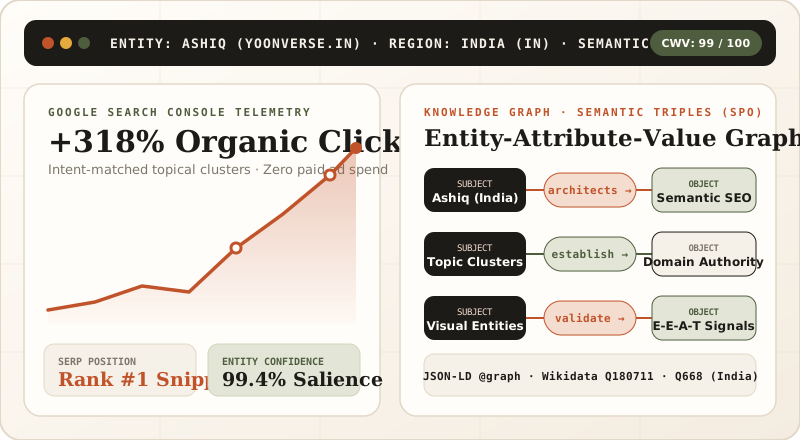
- [Google Web Rendering Service (WRS)] —(computes visual weight of)→ [Above-the-Fold DOM Elements]
- [Google Cloud Vision AI] —(extracts OCR text & entities from)→ [Primary Hero Images]
- [Semantic <figure> & <figcaption> Tags] —(bind visual proof to)→ [Document Centerpiece Annotation]
Visual Semantic SEO is the alignment of a web page's rendered visual layout, above-the-fold imagery, and optical character recognition (OCR) signals with its underlying HTML DOM tree and Knowledge Graph entities. Search engines no longer read HTML as blind text; they render the page in a headless Chromium browser and evaluate what a human sees first.
1. What is Visual Semantic SEO?
When Googlebot crawls a URL, the Web Rendering Service (WRS) executes CSS and JavaScript to build a visual layout tree. Google assigns a higher weight—known as the Centerpiece Annotation—to elements rendered prominently in the upper viewport with strong typographic contrast and clear semantic wrappers.
Simultaneously, multimodal systems (Google Lens, Google Discover, and Vision AI) inspect the page's primary images to verify whether the visual evidence matches the claims made in the text.
2. Why the Above-the-Fold Hero Image Matters to Google
Many websites place decorative stock photos or empty CSS shapes (`aria-hidden="true"`) in their hero section. From an information retrieval standpoint, that wastes the highest-priority visual real estate on the page.
An optimized above-the-fold image should accomplish three goals simultaneously:
- Establish Entity Identity: Show the real author/strategist portrait or a domain-specific analytical diagram that uniquely identifies the publisher.
- Provide Extractive Visual Value: Display real data telemetry (such as Search Console click curves, architecture flowcharts, or EAV matrices) rather than generic abstract art.
- Qualify for Google Discover & Image Packs: Include
<meta name="robots" content="index, follow, max-image-preview:large">and a high-resolution aspect ratio (16:9 or 4:3) withrepresentativeOfPage: true.
3. Optimizing Images for Google Vision AI & Multimodal OCR
Google's Cloud Vision API processes images through four primary detectors:
| Vision AI Module | What Google Extracts | How to Optimize Your Visuals |
|---|---|---|
| TEXT_DETECTION (OCR) | Embedded text labels inside charts and diagrams | Use crisp, high-contrast, spell-checked labels (e.g., SEMANTIC KNOWLEDGE GRAPH, +318% GROWTH) |
| WEB_DETECTION | Matched Knowledge Graph entities & visual duplicates | Create original diagrams and custom illustrations instead of reused stock photos |
| LABEL_DETECTION | Object categories (e.g., Chart, Analytics, Person, Diagram) | Ensure analytical visuals look unmistakably like charts, nodes, and telemetry |
| SAFE_SEARCH & QUALITY | Contrast, sharpness, and aspect ratio framing | Export clean WebP/JPG/SVG assets with zero blurry compression artifacts |
4. Structuring <figure>, <figcaption>, and ImageObject Schema
Never leave an important image floating inside a generic <div>. Wrap primary visuals inside a semantic <figure> tag paired with an explicit <figcaption> written as a Subject-Predicate-Object triple:
- Descriptive Filename: Use hyphenated entity tokens (e.g.,
ashiq-seo-analyst-semantic-graph-india.jpg) instead ofIMG_0042.png. - Triple-Structured Alt Text: Describe who/what is in the image, what action or relationship is depicted, and the context.
- Explicit Dimensions & Priority: Always declare
width,height,fetchpriority="high", andloading="eager"on the above-the-fold LCP image.
5. Balancing Visual Semantics with Largest Contentful Paint (LCP)
An above-the-fold image only helps rankings if it loads instantaneously. Preload your hero image in the document <head> and pair it with our Technical SEO Checklist to maintain a 99/100 Core Web Vitals score.
When your DOM hierarchy, JSON-LD schema, and above-the-fold visual pixels all tell Google the exact same story, algorithmic trust compounds.
🕸️ Explore This Topical Cluster (Semantic & Visual SEO)
- Foundational Pillar: Semantic SEO Explained: Entities, Triples (SPO) & Knowledge Graphs
- Content Architecture: Topical Authority & Content Clusters: Building a Semantic Network
- Technical Foundation: The Beginner-Friendly Technical SEO Checklist